

 Torsional Vibration Not every rotating shaft issue is clearly visible through acceleration vibration or noise. In many cases, the root cause lies in torsional vibration—angular oscillation generated by time-varying torque. Torsional vibration analysis allows detailed tracking of speed and angular variations within each cycle, helping detect torsional resonances, drivetrain irregularities, or the influence of operating conditions.
Torsional vibration is an angular oscillation caused by torque acting on a shaft changing over time. It is the instantaneous deviation of speed and angle from the mean value, often prominent in systems with non-uniform excitation such as internal combustion engines, compressors, or gear transmissions. When elastic components of shafts and couplings are excited near torsional natural frequencies, vibration amplitude can rapidly increase and cause material fatigue.
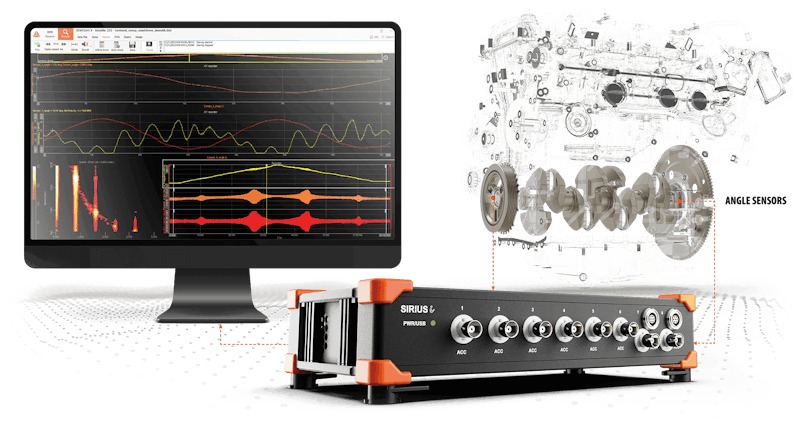
Torsional vibration analysis is based on high-precision measurement of speed and angle, then removing the DC component to reveal the dynamic oscillation. Parameters such as dynamic twist angle, torsional velocity, and angular difference between measurement points on the shaft provide direct insight into torsional deformation during operation. When combined with order analysis, torsional vibration can be linked to specific excitation sources versus speed, supporting engineering decisions based on measured data.