

|
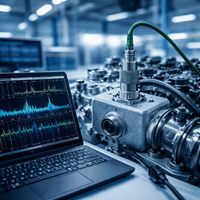
Data acquisition, often abbreviated as DAQ or DAS, is the process of sampling measurement signals from real-world physical phenomena and converting them into digital data that can be processed by computers and software. Unlike traditional recording methods such as strip charts or paper-based instruments, DAQ systems convert signals from the analog domain into the digital domain and then store them on digital media such as ROM, flash storage, or hard drives for display, analysis, and reporting. Today, DAQ is the foundation of many test and measurement systems, enabling engineers to measure accurately, visualize data in real time, and make objective evaluations of performance, safety, and reliability. |
|
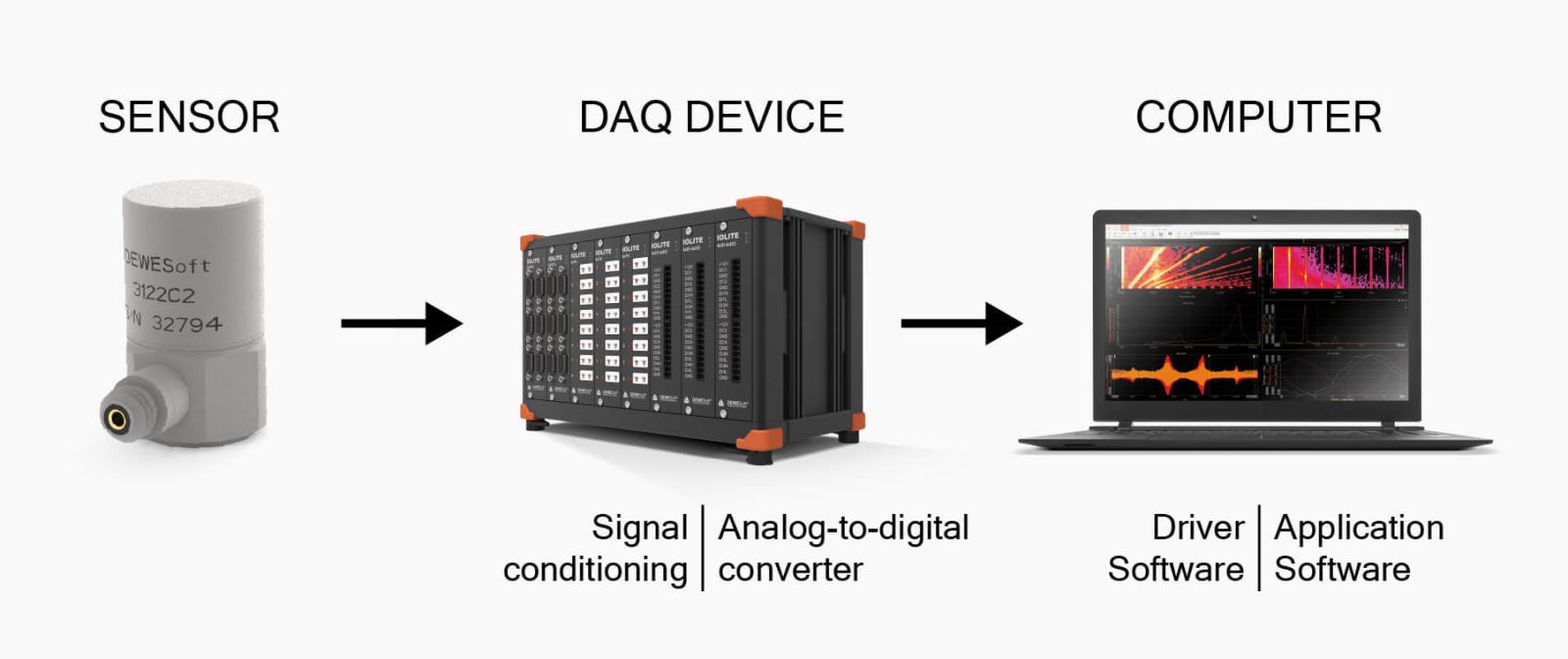
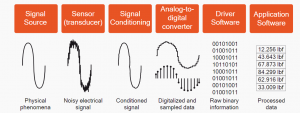
Components of a Data Acquisition SystemA complete DAQ system typically includes the following core components:
These four elements form the complete measurement chain, from real-world physical events to usable digital information for research, testing, monitoring, and product development. |
|
What Does a Data Acquisition System Measure?DAQ systems are designed to measure a wide range of physical quantities. Common examples include:
In addition, data acquisition systems can also measure light, images, sound, mass, position, speed, and many other quantities depending on the sensors and measurement hardware used. |
|
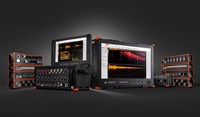
An Easy-to-Use DAQ System from DewesoftThe video below provides an overview of a modern, intuitive DAQ system for measurement and testing applications: |
The Purpose of Data AcquisitionThe primary purpose of a data acquisition system is to record and store measurement data. However, modern DAQ systems also provide real-time visualization, post-processing, analysis, and reporting capabilities. A major development in recent years is the combination of data acquisition and control, where high-end DAQ systems are tightly integrated with real-time control systems to support advanced test scenarios. Typical purposes of DAQ include:
|
|
DAQ devices are also widely used in monitoring applications such as:
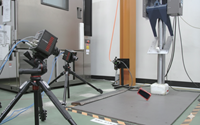
Why Data Acquisition Systems MatterDAQ systems are essential for testing and validating products ranging from vehicles and aircraft to medical devices and industrial machinery. In the past, many tests relied heavily on subjective human judgment. With DAQ, those judgments are replaced by objective measurements that can be repeated, compared, and analyzed mathematically. For example, in automotive suspension testing, engineers no longer need to rely only on driver feedback. They can measure vibration, load, force, displacement, and other quantities simultaneously to make more accurate evaluations of system performance. Today, virtually no one wants to develop vehicles, aircraft, medical equipment, or electromechanical systems without using DAQ to objectively assess performance, safety, and durability. Example of extreme load testing on a truck with Dewesoft |
|
The Measurement ProcessData acquisition is the process of converting real-world signals into the digital domain for display, storage, and analysis. Since physical phenomena exist in the analog domain, they must first be measured in the field and then converted into digital form. This process is carried out using sensors, signal conditioning circuitry, and A/D converters. The resulting data is then streamed over time into digital storage, forming a complete measurement system.
|
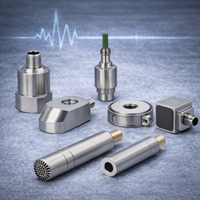
Sensors and Transducers in a Measurement SystemAny measurement of physical phenomena such as temperature, sound, vibration, or displacement begins with a sensor, also known as a transducer. A sensor converts a physical quantity into a measurable electrical signal. Common sensor types include:
Depending on the sensor type, its electrical output may be voltage, current, resistance, or another time-varying electrical property. These signals are usually sent to a signal conditioner before digitization. |
Signal ConditioningSignal conditioners take the analog output from sensors and normalize it before sending it to the digitizer. Depending on the sensor type, signal conditioning may include amplification, linearization, excitation, filtering, balancing, and galvanic isolation. For example, in a temperature measurement system, the conditioning circuit may need to linearize the sensor output and also amplify and isolate the very small voltage before digitization.
Each sensor type requires appropriate signal conditioning to ensure linearity, accuracy, and measurement fidelity. |
Galvanic IsolationGalvanic isolation means separating the measurement circuit from other electrical potentials. This is especially important in measurement systems because many sensor signals are very small and easily affected by external voltages or electrical noise. For example, if a sensor is mounted directly on a test object at a different ground potential, the measured signal may include a large DC offset. AC noise from the surrounding environment or from other electrical components can also degrade signal quality. That is why the best DAQ systems provide isolated inputs to preserve signal integrity and improve measurement accuracy. The following video explains why galvanic isolation is important in DAQ systems: |
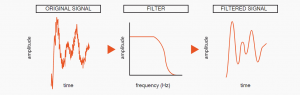
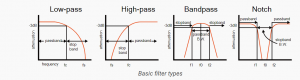
Signal FilteringAlmost every signal we want to measure can be affected by electrical noise or environmental interference. Noise may come from surrounding electromagnetic fields, high-gain signal paths, or voltage differences between the sensor, the measurement system, and the test object. For this reason, good signal conditioning systems provide selectable filters that engineers can use to remove unwanted noise and improve measurement quality.
Some basic types of signal filtering
|
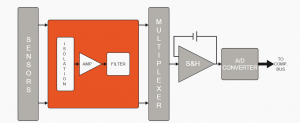
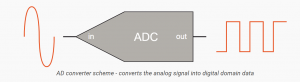
Analog-to-Digital Converters (ADC)The output of most signal conditioning circuits is still an analog signal, so an ADC is required to convert that signal into a high-speed stream of digital values for display and storage in the DAQ system.
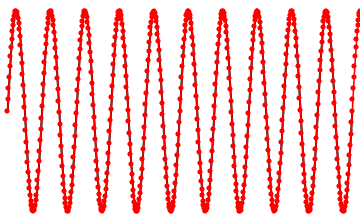
There are different ADC architectures, including multiplexed converters and systems with one converter per channel. Multiplexed ADC systems are lower in cost, but they cannot perfectly align all channels in time because signals are converted sequentially. This introduces time skew between channels. In modern DAQ systems, 24-bit ADCs are commonly the standard for high-quality dynamic measurements, while 16-bit ADCs are often considered the minimum for many general-purpose signals. The conversion rate is called the sample rate. Some measurements, such as temperature, do not require high speed, but applications such as AC voltage, AC current, shock, and vibration often require tens of thousands or even hundreds of thousands of samples per second or more. A 16-bit ADC can theoretically divide amplitude into 65,536 levels, while a 24-bit ADC can reach 16,777,216 levels. This allows the system to represent signals with very high amplitude resolution. As a result, ADCs with high sample rates and high resolution are ideal for dynamic signal analysis such as shock and vibration, while lower sample rates with high resolution are well suited for slowly changing quantities such as temperature. ADCs that include anti-aliasing filters (AAF) are especially desirable in dynamic measurement applications because they help prevent measurement errors caused by undersampling.
|
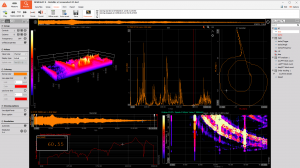
Data Visualization and DisplayOne of the most important functions of any DAQ system is the ability to visualize data in real time while it is being recorded. Waveform data can almost always be displayed as Y/T charts, tables, bar graphs, FFT frequency plots, and many other formats. Today’s most flexible DAQ systems allow users to freely configure one or more display screens using built-in graphical widgets. DewesoftX provides a wide range of powerful visualization tools, including:
|
The video below shows DewesoftX data visualization tools in action: |
Data AnalysisA DAQ system not only provides a critical real-time visual reference during testing, but once data is stored, it can also be analyzed further using built-in tools in the DAQ system or third-party data analysis software. Most DAQ systems on the market today support exporting data into various formats for offline analysis, allowing users to integrate the measurement workflow with external tools and reporting processes.
Learn more about DAQ system types here. |
SummaryDAQ is the core foundation of modern measurement systems, enabling real-world physical phenomena to be converted into digital data for display, storage, analysis, and decision-making. A complete DAQ system includes sensors, signal conditioning, ADCs, and software. When these components are properly integrated, engineers can perform accurate, synchronized, and reliable measurements in testing, monitoring, research, and product development applications. With powerful hardware and software such as DewesoftX, modern DAQ systems do far more than record data. They also enable real-time visualization, advanced analysis, and higher efficiency throughout the entire measurement process. |